
Your cousin just dropped a wild clip in the family group chat. Half the thread is already typing "OMG." Mom texts you: "Is this real?"
We've all been there. That "is the Pope in a puffer jacket" energy. Looks real. Feels urgent. And somehow you're the designated fact-checker for the whole chat.
Here's what works better than a lecture: sit with her for five minutes, check one video together, and leave a short note on her phone she can open next time something feels off.
Short answer: one shared check, then a five-line "check before you share" note she owns.
Why a shared check beats a speech
Lectures make people dig in. A shared check puts you on the same team.
You're not correcting her. You're saying, "Want to look at this one together?" She stays in charge of what she shares. You stay useful. That respect matters more than any tip list.
A couple of posts on X earlier this month named the same feeling: a mom asking if a wild clip was true, and someone trying to talk about AI fakes without sounding rude. I'm linking those for context only (GoldenMole19, judyreinard). People want a way to help that still honors their mom.
Pick one video. Check it together.
Ask her to open the clip she's already wondering about. Watch it once, all the way through. Then walk these five steps out loud, together.
1. Pause before you share
If the video makes you feel shocked, angry, or ready to hit Share, stop for one breath. Strong feelings are a cue to slow down, not hurry. You can always share later. You can't unshare easily.
2. Ask where it came from
Who posted it? A person she trusts? A news account she recognizes? A brand-new page with a dramatic clip? Tap through to the original when you can. Look for when it first showed up. A brand-new account pushing something wild is a reason to wait.
3. See if a trusted news site has it
Search a few words from the claim on Google or Bing, plus "fact check" or the name of a news outlet she already trusts. If major outlets are covering it, you'll usually find clear reporting. If nobody reliable has it, that doesn't prove it's fake. It does mean "wait" is a smart move.
4. Look closely at hands, faces, text, and sound
Pause on a few frames. Do hands look odd or melt into objects? Do teeth, glasses, or jewelry shift between frames? Is text on signs garbled? Does the mouth match the words?
Clues. Not proof. Real videos can look messy too, and newer AI can hide some of the old tells. Still, looking closely together trains the eye better than any warning speech.
5. Reverse-search one clear frame
This is the neat trick. Screenshot a clear moment (a face, a landmark, a sign, or a wide shot). Open Google and use Search by image, or open Google Lens on her phone, and upload that frame.
You're looking for an earlier version, a different caption, or a news story that explains the clip. Finding an older original with a different story is a big clue. Finding nothing proves very little. Fresh real footage and a fresh fake can both come up empty.
If she wants a second search, TinEye or Bing Visual Search can help too. Same idea: search the still, not the whole video file.
Save this note on her phone
Open Notes (or whatever she already uses). New note. Title it Check before you share. Paste these five lines:
1. Pause before I share.
2. Who posted this, and when?
3. Has a news site I trust covered it?
4. Hands, faces, text, or sound look off?
5. Screenshot one frame. Reverse-search it.
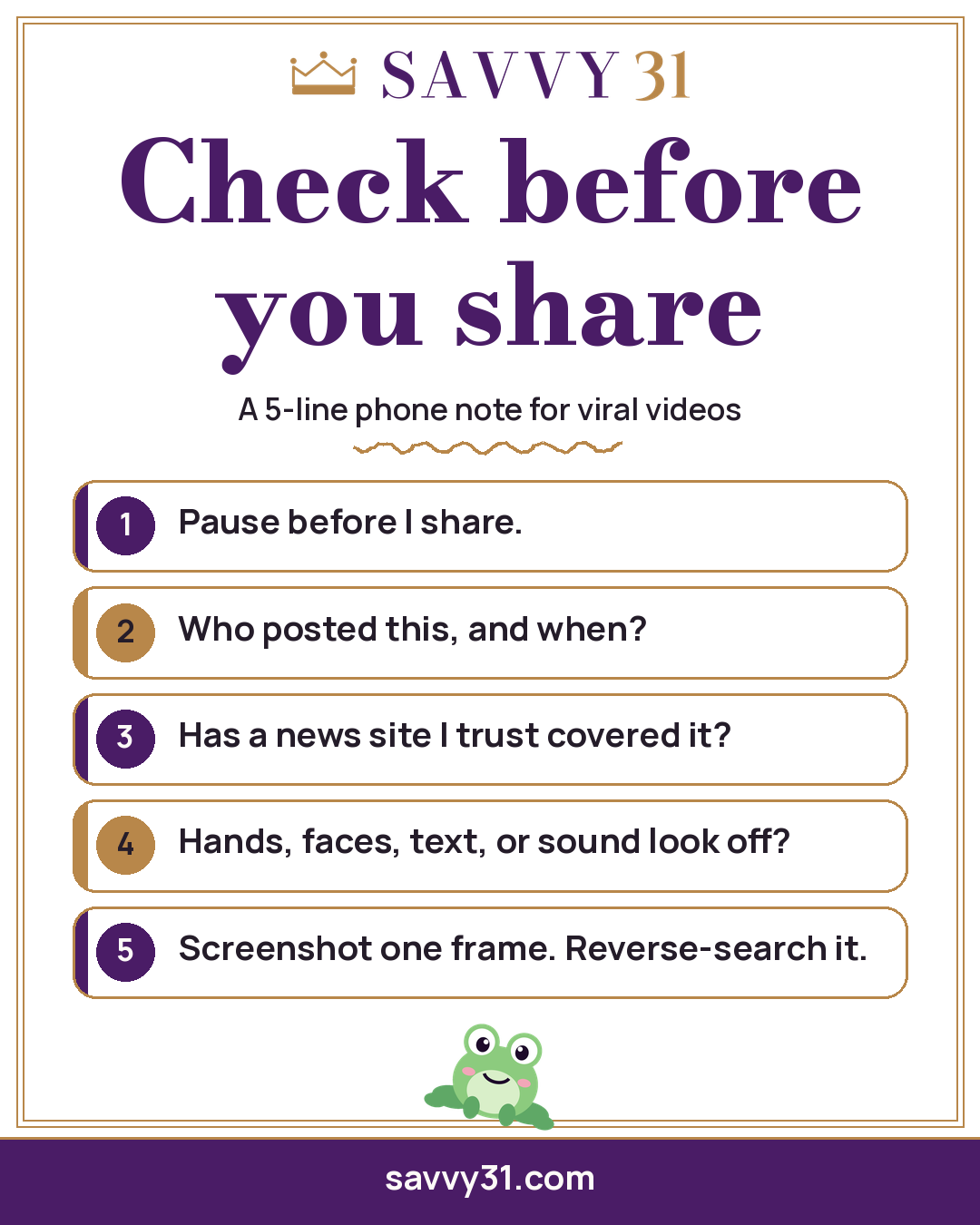
That's it. Five lines. Next time a clip feels weird, she opens the note and runs the list. You're not the gatekeeper. She is.
A few calm things to say out loud
Say these with her, not at her:
- AI can make very real-looking video now. Wild clips can still be real. A quick check is still worth it.
- Waiting is allowed. Sharing later is fine. Sharing something false feels worse.
- You don't have to catch every fake. You just need a habit for the ones that matter to you.
If she wants more plain-English AI help later, Bot Cheat Sheet has short guides. No pressure. The phone note is enough for today.
What I'd want someone to do for me
Skip the lecture. Sit down. Pick the video she's already wondering about. Walk the five steps. Save the checklist. Then let her decide what to share.
That's how I'd want someone to help me too.
Got a question about AI in your everyday life? Send it my way. It might be next week's post. 💜
Jodi