
AI is here, whether we like it or not. When we talk with friends about it, the first worry usually isn't whether they'll do it wrong. It's what happens to what they type. That's a smart question. Here are five simple rules we follow, plus the setting worth checking in the tools most people use.
Rule 1: Treat it like a postcard, not a diary
Assume anything you type could be seen by someone else. Google says some Gemini chats are reviewed by people to improve its services, and asks you not to enter anything confidential you wouldn't want a reviewer to see. Anthropic, the company behind Claude, recommends being thoughtful about sharing financial details, health records, passwords and confidential documents.
Never paste in: passwords, Social Security numbers, card or bank numbers, medical records, or anyone else's private details.
Rule 2: Swap in placeholders
You can get the same great help without the private parts. Instead of a client's full name and address, write [Client], a family of four moving across town. Instead of your real account numbers, write [my bank]. AI doesn't need the details to help you with the wording.
Rule 3: Check the training setting (it takes one minute)
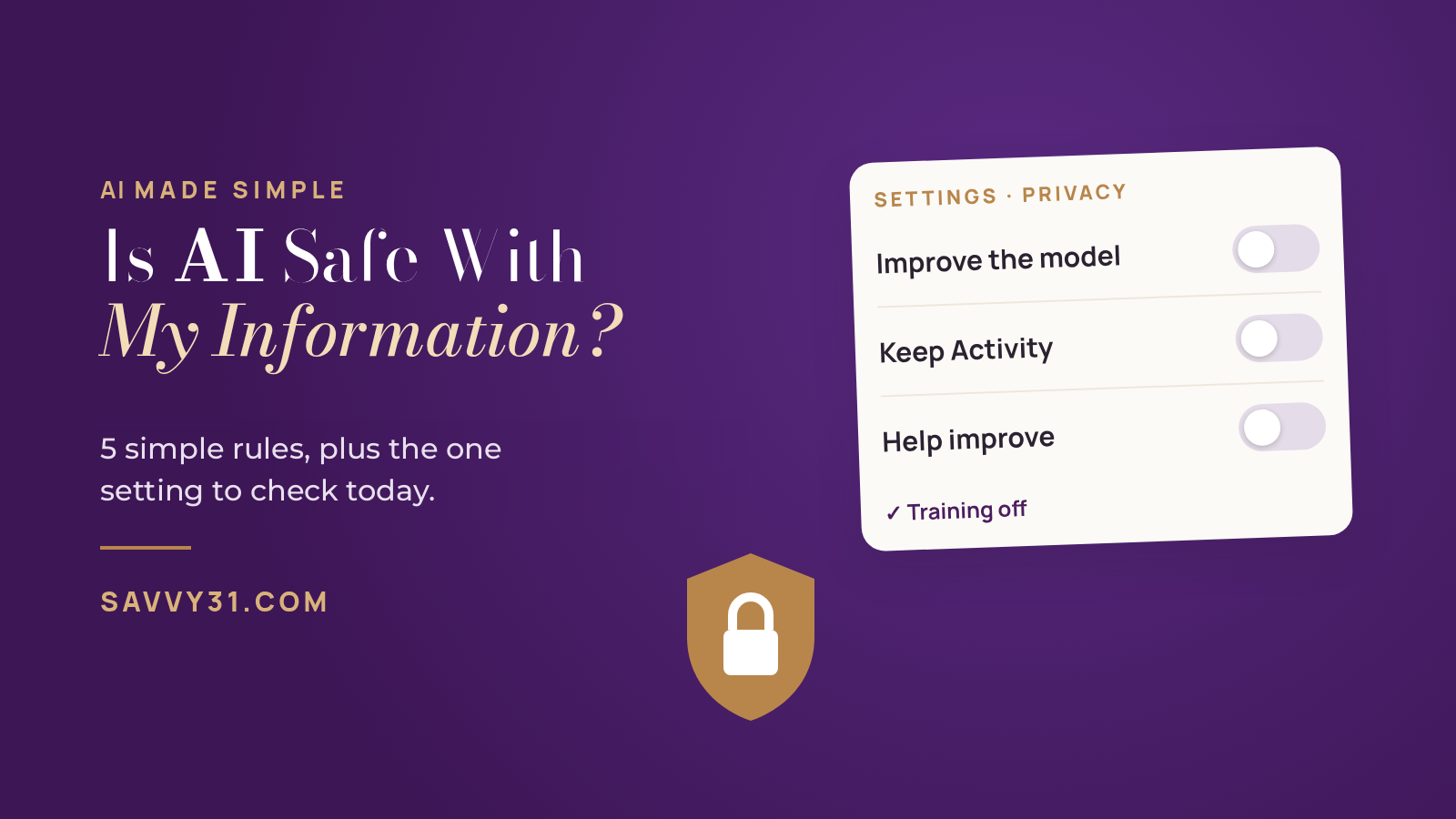
In many free and personal plans, your chats can be used to improve the AI unless you turn that off. Here's where to look, as of October 2026:
- ChatGPT: Settings, then Data controls, then turn off Improve the model for everyone. OpenAI says new conversations then won't be used to train its models, and your chat history stays.
- Gemini: Settings & help, then Activity, then turn off Keep Activity. Google says it then won't use your future chats to improve its AI unless you send feedback, though it still keeps chats for up to 72 hours to run the service.
- Claude: Settings, then Privacy, then turn off Help improve Claude. Anthropic says new chats then won't be used for future model training.
One more thing: pressing thumbs up or thumbs down can share that conversation as feedback, even with training off. OpenAI and Google both say so.
Rule 4: Use temporary or incognito chats for anything sensitive
ChatGPT has Temporary Chat, Gemini has temporary chats and Claude has incognito chats. Each company says these aren't used to train its models. They aren't totally invisible either. OpenAI says temporary chats may be kept up to 30 days for safety, and Google keeps them for 72 hours.
Rule 5: You're still the one who decides
AI can sound confident and still be wrong. Read before you send, double check numbers and dates, and never let it make a money, health or legal decision for you. Try asking it what you should double check in its answer. It will tell you.
The bottom line
AI is safe enough to make your life simpler when you treat it like a smart, slightly nosy assistant: helpful, but not someone you hand your passwords to. Five rules, one setting, and you're good to go.
Curious about connecting AI to your email? We wrote a whole post on that: Is It Safe to Give an AI Bot Access to Your Email?
Which of these rules was new to you?
Kimber and Jodi
Sources
Checked October 26, 2026.