
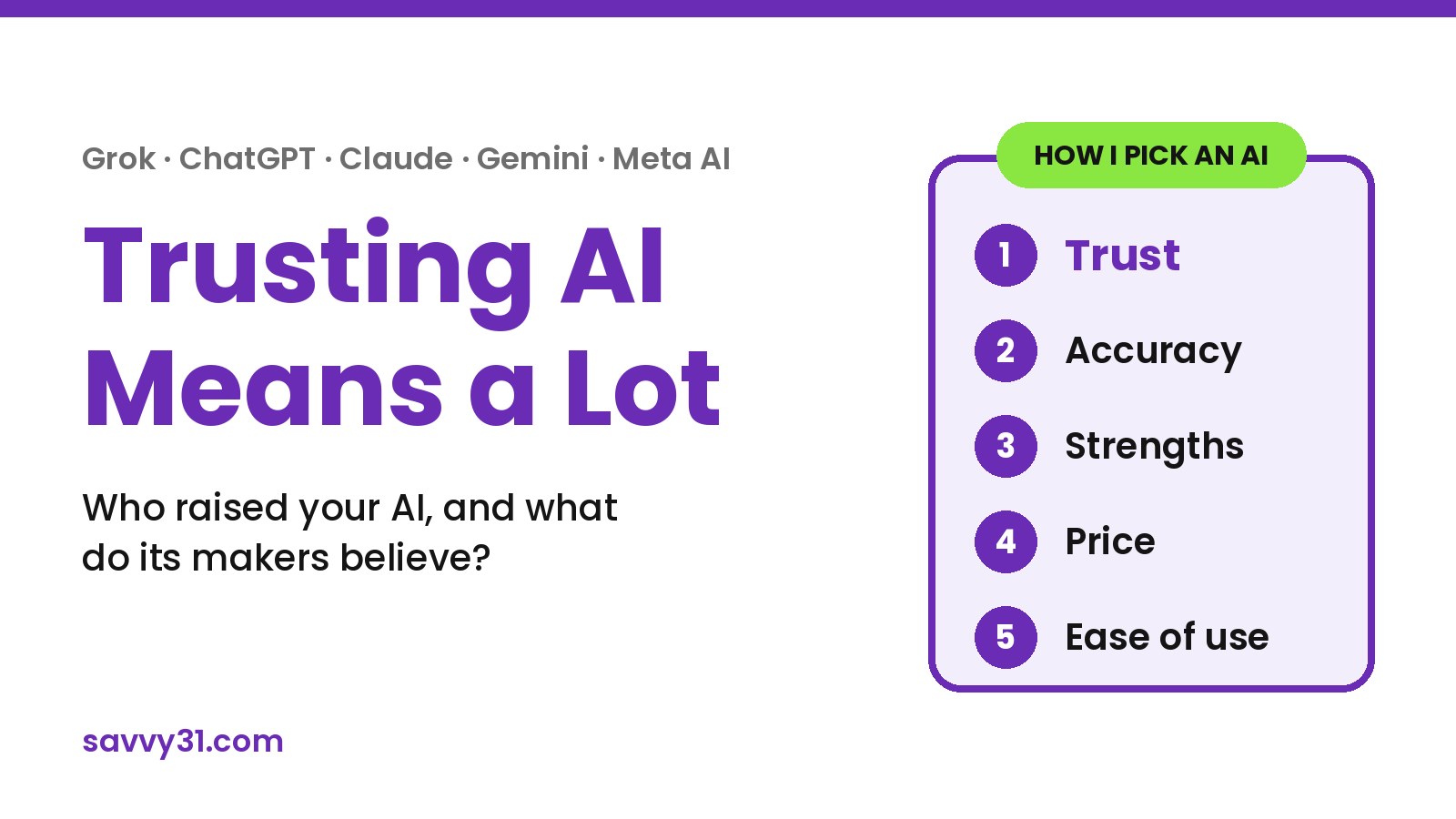
The bottom line (30-second version) - Pick an AI the way you'd pick a babysitter: trust first. - My five steps: Trust → Accuracy → Strengths → Price → Ease of use. - The quickest trust test: do they show their rules? - My pick: Grok. I can read its instructions, and Grok Bot is the whole package for $30.
Think about who you trust with your kids, your calendar or your bank login. You don't just look at what they can do. You want to know who they are, how they were raised and what they believe.
For me, it wasn't one big moment. It was a whole bunch of reading and thinking. I keep seeing posts asking, "Does AI believe in God? Is it right or left? Which way does it lean politically? Who built this?" Every time, it makes me stop and think.
If AI is going to know everything about me, who am I going to trust with that information? Who do I really want to get to know? And what if it thinks differently than I do? I'm more in the center, and an AI might lean right or left. It makes you think about the future and all the "what ifs."
I think AI deserves the same question. These helpers read our email, plan our weeks and sometimes act for us. So before I hand one the keys, I want to know who shaped it.
Here's my order for picking an AI:
- Trust: how it was raised, who owns it and what they believe. This matters most to me.
- Accuracy: whether its answers are actually right.
- Strengths: what it's really good at.
- Price: what you get for the money.
- Ease of use: how simple it is day to day.
Am I the only one who thinks trust comes first?
Nope. Menlo Ventures' 2026 State of Consumer AI report asked US AI users what matters most when they choose an AI. Accuracy came first (45%), then trustworthiness (40%) and security and privacy (36%). Ease of use came fourth (32%), down from 38% the year before.
So most people agree with me that trust and safety beat ease of use. The one difference: people put accuracy (45%) just ahead of trust (40%). I still put trust first. That's my opinion, not a statistic. I want to know who raised it before I even ask it a question. That survey didn't ask about price, so I can't tell you where price ranks for most people.
First, how does any AI get "raised"?
Every big AI grows up in roughly three stages:
- It reads. It learns from a huge pile of text, mostly from the internet and books. That's where it learns to talk.
- People coach it. Human reviewers rate its answers ("this one's better than that one"), and it learns from those ratings. The industry calls this human feedback.
- It gets house rules. Each company writes down how it wants its AI to behave. This is where the five companies really differ.
1) Trust: how each one was raised
Grok (from xAI, the maker of Grok Bot)
- Who coaches it: xAI has hired large teams of people it calls "AI tutors" to label data and help train Grok (Business Insider).
- The house rules: xAI's stated mission is to "advance our collective understanding of the universe" (x.ai/about).
- What the founder says: When he launched xAI, Elon Musk said: "The safest way to build an A.I. is actually to make one that is maximally curious and truth-seeking." When Grok 3 came out, he said Grok aims to be "a maximally truth-seeking AI, even if that truth is sometimes at odds with what is politically correct."
- Where it shines: xAI publishes Grok's behind-the-scenes instructions (its "system prompts") on GitHub, so anyone can read them. That started in May 2025, after an employee made an unauthorized change that made Grok go off the rails (Reuters, The Verge).
- My honest take: I love that I can actually read the instructions. And like every AI, it's had public stumbles.
ChatGPT (from OpenAI)
- Who coaches it: OpenAI made "learning from human feedback" famous. Human reviewers rated answers to make ChatGPT more helpful.
- The house rules: OpenAI publishes a Model Spec that describes how its models should behave. It says the goal is models that are "useful, safe, and aligned with the needs of users and developers." OpenAI also admits its "production models do not yet fully reflect the Model Spec."
- What the founder says: Sam Altman wrote: "Our mission is to ensure that AGI (Artificial General Intelligence) benefits all of humanity." (AGI means AI that's as capable as people across many kinds of work.)
Claude (from Anthropic)
- Who coaches it: Dario Amodei explained that most chatbots learn from people rating answers, which "can be a little bit opaque." Claude adds something else.
- The house rules: Claude is trained on a written constitution. Amodei said: "Constitutional AI is based on training the model to follow an explicit set of principles." The constitution asks Claude to be broadly safe, broadly ethical, to follow Anthropic's guidelines and to be genuinely helpful, in that order. Anthropic also says Claude's "behavior might not always reflect the constitution's ideals."
- What the founder says: Amodei compared the constitution to a letter from a parent "that you read when you grow up. It's a little bit like it's telling you who you should be."
Meta AI and Muse (from Meta)
- What it learns from: Meta says it trains its AI on public posts, comments and photos from adults on Facebook and Instagram, and on people's chats with Meta AI. Private messages and accounts of people under 18 are left out.
- The house rules: I couldn't find a single public behavior rulebook from Meta like the Model Spec or Claude's constitution. The clearest public statement of its direction is Mark Zuckerberg's "Personal Superintelligence" letter.
- What the founder says: Zuckerberg wrote: "Meta's vision is to bring personal superintelligence to everyone. We believe in putting this power in people's hands to direct it towards what they value in their own lives."
Gemini (from Google)
- What it learns from: Google says Gemini first learns from a huge amount of data. Then it's coached with carefully chosen examples of excellent answers, plus "Reinforcement Learning from Human Feedback," where people rate answers against each other. Google also says it relies on "a global network of raters to help train and test Gemini."
- The house rules: Google publishes its AI Principles, which promise "appropriate human oversight, due diligence, and feedback mechanisms." It also publishes a page called "Our approach to the Gemini app." That page admits: "we won't always get it right."
- What the leaders say: Google CEO Sundar Pichai said he thinks of AI "as the most profound technology humanity is working on. More profound than fire, electricity, or anything that we have done in the past." Google DeepMind CEO Demis Hassabis said: "We have a real opportunity to deliver AI research and products that dramatically improve the lives of billions of people, transform industries and advance science."
Do they show their rules?
This one's big for me. The more open a company is about how they program their AI to think and act, the more it builds trust with us. The more they hide it, the more skeptical I get. That's my opinion, but here's what each company actually shows you: - xAI (Grok): publishes Grok's actual behind-the-scenes instructions (system prompts) on GitHub, where anyone can read them. - Anthropic (Claude): publishes Claude's full constitution. - OpenAI (ChatGPT): publishes its Model Spec. - Google (Gemini): publishes its AI Principles and a Gemini "approach" page. These are broader principles, not a detailed rulebook. - Meta (Meta AI / Muse): publishes Zuckerberg's vision letter and explains what data it trains on. I couldn't find one public behavior rulebook.
Only one of them lets you read the exact instructions the AI is running on, and that's Grok.
So who do I trust?
They each have a real belief system: - Grok: truth-seeking and curiosity. - ChatGPT: benefiting everyone. - Claude: a written set of values. - Gemini: responsible development and big scientific progress. - Meta: putting the power in your hands.
What tips it for me is being able to see the instructions, and that's where Grok shines. Your gut might land somewhere else, and that's OK. That's exactly why it's worth asking.
2) Accuracy
I want to trust it first, and then hope it's accurate.
Here's how I think about the difference: - Trust is about the company: who built it, what they believe and what rules they gave it. - Accuracy is about each answer: did it get this particular fact right?
A company you trust can still give you a wrong answer. Every AI can make things up. The industry calls it "hallucinating," and none of these five is immune.
How I check accuracy: - Ask for sources. Say "Show me where you found that," and click the link. - Double-check the facts that matter. Look up anything about health, money, legal stuff or your family. - Watch for too-perfect answers. Very specific numbers, quotes or dates are worth a quick check. - Ask it again another way. If the answer changes, slow down.
3) Strengths
- Grok / Grok Bot: a team of helpers, each with its own computer, that keeps working while you're away. Grok, AI images and video, and X come on the same plan.
- ChatGPT: the best-known name, with thousands of app connections. Its newer Dots agent is on the $100+ Pro plan.
- Claude: known for careful writing and work tasks. Its new Duet agent is a US waitlist preview.
- Gemini: built into Gmail, Docs and Search. Google AI Pro also comes with 5 TB of storage.
- Meta AI / Muse: free to try and built into apps lots of people already use.
4) What you get for the price (checked Oct 22, 2026)
- Grok Bot: $30 a month on the Premium plan.
- ChatGPT Dots: need ChatGPT Pro, from $100 a month.
- Claude Duet: comes with Claude Pro, $20 a month.
- Gemini: free, or Google AI Plus at $4.99, Google AI Pro at $19.99 and Google AI Ultra from $99.99 a month.
- Muse: free, or $20 a month for more use.
(Want the full side-by-side? See our How to Choose Your AI post.)
5) Ease of use
All five let you just talk or type, like texting a friend. The bigger difference is setup. How many apps does it connect to, and how often does it check with you before acting? Try each one on one small chore before you trust it with a big one.
Other AIs to know
- Microsoft Copilot: Microsoft's helper, built on OpenAI's models (including GPT-5). It's tied into Windows, Edge and Microsoft 365.
- Perplexity: a research tool that answers with numbered links to its sources. That makes it easy to check accuracy.
- Mistral: a French AI company whose chat assistant is called Le Chat.
- DeepSeek: a Chinese AI company. Its own privacy policy says it will "directly collect, process and store your Personal Data in People's Republic of China." Wired reported on what that means for US users. Think twice before sharing anything personal with it.
Why this matters (the big picture)
These tools are becoming the helpers we hand our families' calendars, our money and our words to. Choosing one is really choosing whose values sit inside your home every day. I'd rather choose with my eyes open, for me and for the people I love.
My simple checklist before you trust an AI
- Who owns it, and what do they say they believe? Read the mission in their own words.
- Do they show their rules? Look for a published rulebook (Model Spec, constitution, AI Principles) or the actual instructions (Grok's system prompts). If they hide it, be more careful.
- Does it ask before it acts? Keep approvals on for money, your address and sending messages.
- Check its accuracy. Ask for sources and double-check anything important.
- Test it small. Give it one low-risk chore and check the work.
- Then think about strengths, price and ease of use.
Trusting AI means a lot, so pick the one whose upbringing you'd trust with your stuff.
FAQ
Do these AIs learn from my private messages? It depends on the company and your settings. Meta says it leaves out private messages. Check each app's privacy settings.
Which AI company publishes its rules? xAI publishes Grok's system prompts on GitHub. Anthropic publishes Claude's constitution. OpenAI publishes its Model Spec. Google publishes its AI Principles. Meta shares its vision and training-data approach, but I couldn't find one public behavior rulebook.
Is DeepSeek safe to use? Its own privacy policy says it stores your data in China. If that worries you, don't share anything personal with it.
What does Gemini cost? It's free to start. Google AI Plus is $4.99 a month, Pro is $19.99 and Ultra starts at $99.99.
Is any AI completely unbiased? No. Every AI is shaped by its data, its human reviewers and its rules. That's why knowing who raised it matters.
Can AI make things up? Yes, all of them can. Ask for sources and double-check anything important.
What do most people care about when choosing an AI? In Menlo Ventures' 2026 survey: accuracy (45%), trustworthiness (40%), security and privacy (36%), then ease of use (32%).
Sources
For my Route Planners: every fact and quote above is linked here, so you can check it yourself. - Menlo Ventures, 2026 State of Consumer AI: https://menlovc.com/perspective/2026-the-state-of-consumer-ai/ - xAI, About: https://x.ai/about - Musk, xAI launch Twitter Space (2023), reported by Fortune via Yahoo Finance: https://finance.yahoo.com/news/elon-musk-wants-create-superintelligent-205636599.html - Musk on Grok 3 (Deseret News, Feb 18, 2025): https://www.deseret.com/business/2025/02/18/elon-musk-xai-grok3-unveiling-artifical-intelligence-chatbot-chatgpt-openai-sam-altman-donald-trump/ - xAI "AI tutors" (Business Insider): https://www.businessinsider.com/elon-musk-xai-hiring-spree-ai-tutors-2024-10 and https://www.businessinsider.com/xai-elon-musk-hiring-ramp-up-data-annotators-2025-2 - Grok system prompts on GitHub: https://github.com/xai-org/grok-prompts/ ; The Verge: https://www.theverge.com/news/668527/xai-grok-system-prompts-ai ; Reuters: https://www.reuters.com/business/musks-xai-updates-grok-chatbot-after-white-genocide-comments-2025-05-17/ - OpenAI Model Spec: https://model-spec.openai.com/2025-10-27.html - Sam Altman, "Three Observations": https://blog.samaltman.com/?page=1 - Anthropic, Claude's Constitution: https://www.anthropic.com/constitution - Amodei on Constitutional AI (Fortune interview, via Yahoo Finance): https://finance.yahoo.com/news/anthropic-ceo-says-why-quit-194409797.html - Amodei "parent... letter" quote (NYT "Interesting Times" interview, as transcribed on New Savanna): https://new-savanna.blogspot.com/2026/02/claudes-constitution-and-other-matters.html - Zuckerberg, "Personal Superintelligence": https://www.meta.com/superintelligence/ - Meta, AI training on public posts (EU): https://about.fb.com/news/2025/04/making-ai-work-harder-for-europeans/ ; Reuters: https://www.reuters.com/technology/artificial-intelligence/meta-use-public-posts-ai-interactions-train-models-eu-2025-04-14/ - Google, How Gemini works: https://gemini.google/overview/ - Google, Our approach to the Gemini app: https://gemini.google/our-approach/ - Google AI Principles: https://ai.google/principles/ - Gemini technical report (human feedback and raters): https://arxiv.org/html/2312.11805v3 - Google AI plan prices: https://one.google.com/about/google-ai-plans/ - Pichai, 60 Minutes (Business Insider): https://www.businessinsider.com/sundar-pichai-google-ai-bard-profound-tech-human-history-2023-4 - Hassabis quote (Google DeepMind careers page): https://deepmind.google/careers/ - Microsoft, GPT-5 in Copilot: https://news.microsoft.com/source/features/ai/openai-gpt-5/ - Perplexity: https://www.perplexity.ai/ - Mistral, "Mistral has entered the chat" (Le Chat): https://mistral.ai/news/mistral-chat/ - DeepSeek privacy policy: https://cdn.deepseek.com/policies/en-US/deepseek-privacy-policy.html ; Wired: https://www.wired.com/story/deepseek-ai-china-privacy-data/ - OpenAI, human feedback / InstructGPT: https://openai.com/index/instruction-following/
Want help choosing your AI? Visit savvy31.com or book a free call, and we'll walk you through it. Want the side-by-side on AI helpers? Read How to Choose Your AI.